
Building synthetic data pipelines: Ray
/ 4 min read
Part 2: Building with Ray
This is Part 2 of a 2-part series on building production-ready, multi-layer RAG systems with Ragforge.
- Part 1: Building with Ractor
- Part 2: Building with Ray (you are here)
Scaling beyond one box: where Ray and Anyscale actually fit
Everything in Part 1 is a single binary on a single machine. I want to be precise about what comes next: I have not built or tested a Ray version of this pipeline.
What follows is the migration path I would take if this had to become a 100M-patient production job, or if clinical note generation moved from templates to an LLM. It’s a design, not a completed port.
Think of it as a spectrum:
for-loop [simple, slow] -> Ractor on Tokio [concurrent, deterministic, laptop-scale] -> Ray on Anyscale [distributed, elastic, cluster-scale]I picked Ractor first on purpose to prove correctness and byte-identical determinism on a laptop before paying the distributed systems tax.
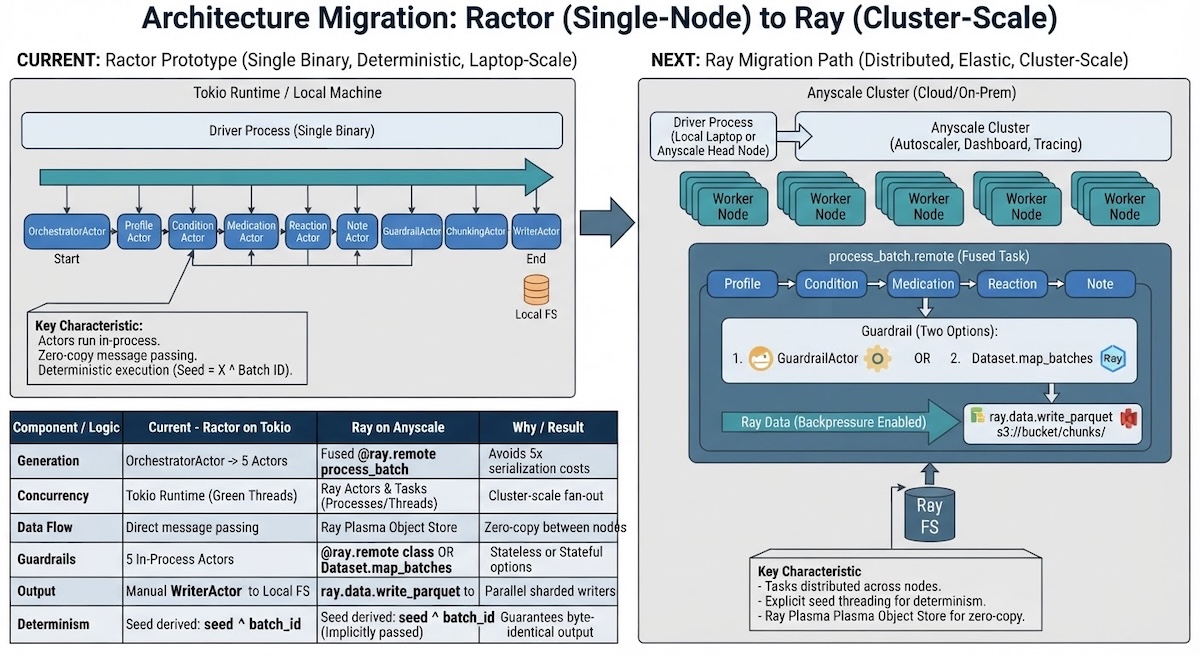
The architecture, side-by-side
Current: Deterministic single binary
Tokio RuntimeOrchestratorActor -> Profile -> Condition -> Medication -> Reaction -> Note -> GuardrailActor -> ChunkingActor -> Writer all in-process, zero-copy message passing via RactorNext: Same logic, different runtime
Driver [local laptop OR Anyscale head node] | ray.init[address="auto"] v+----------------------------------------------------+| Anyscale Cluster - autoscaler + Ray Dashboard + || spot instance recovery + per-task tracing |+----------------------------------------------------+ | futures = [process_batch.remote[seed, batch_id] for batch_id in range[N]] v+----------------------------------------------------------------+| process_batch.remote[] - ONE fused Ray task per batch || Why fused? Mirrors src/generation.rs. 5 separate tasks = || 5 hops + 5 cloudpickle serializations. 1 task = 0 hops. || profile -> condition -> medication -> reaction -> note |+----------------------------------------------------------------+ | batches into Plasma object store [zero-copy between workers on same node] v+----------------------------------------------------------------+| Guardrail [two options]: || 1. @ray.remote class GuardrailActor - stateful counters || 2. ray.data.Dataset.map_batches[guardrail_filter] - stateless |+----------------------------------------------------------------+ | ray.data gives you backpressure here for free [current Ractor version dispatches all batches at startup] vray.data.write_parquet["s3://bucket/chunks/"] // sharded writersComponent-level mapping - nothing in logic changes, only the wrapper
| Current - Ractor on Tokio | Ray on Anyscale | Why |
|---|---|---|
OrchestratorActor dispatching GeneratePatientBatch | Driver: batch_ids = range[total_batches] submitted as futures | Same fan-out, now across nodes |
Profile -> Condition -> Medication -> Reaction -> Note | One fused @ray.remote def process_batch | Avoids serialization cost |
GuardrailActor with 5 checks | @ray.remote class GuardrailActor OR Dataset.map_batches[] | Stateful stats vs. stateless filter |
ChunkingActor -> PatientWriterActor | ray.data.write_json/parquet[] | S3 sharded writers, no manual chunking |
EvalOrchestrator reloads patients.jsonl from disk | ray.data.read_json[].map_batches[generate_evals] | No reload, shuffle is native |
rng.rs: ChaCha8Rng[seed ^ batch_id] | seed ^ batch_id passed explicitly into each task | Same contract, different library. This is how you keep byte-identical |
A more concrete sketch
The key contract from src/rng.rs survives: determinism comes from seeding, not from scheduler order.
import ray
ray.init(address="auto")  # locally: local cluster. on Anyscale: autoscaling cluster
@ray.remotedef process_batch(seed: int, batch_id: int, start_id: int, size: int, cfg: dict):    # mirrors src/rng.rs - explicit seed derivation, no global RNG    base_rng = seed ^ batch_id    records = [make_patient(base_rng ^ i, start_id + i, cfg) for i in range(size)]
    # mirrors src/actors/guardrail.rs - inline, so failure loses 1 batch not the job    return [r for r in records if not has_pii_or_dup(r)]
# Driver - 100M / 1000 = 100k tasks. Anyscale adds nodes as this queue grows.futures = [process_batch.remote(42, b, b * 1000, 1000, cfg) for b in range(100_000)]ds = ray.data.from_pandas([ray.get(f) for f in futures]) # Ray handles object store spillingds.write_parquet("s3://bucket/chunks/")
For LLM notes, only the last step changes:
# Ray Serve handles GPU scheduling + continuous batching# Rust binary would need a Python sidecar or FFI for thisserve.run(llm_note_generator.bind(), route_prefix="/notes")Where this wins, where it loses
Worth it when:
- You OOM on one box. 100k patients fits in RAM. 100M doesn’t. Ray shards the work with no code change -
range[100]becomesrange[100_000]. - Notes become an LLM.
ray.servegives you GPU autoscaling and batching. In Rust you’d be building it yourself. - You need ops for free. Anyscale gives you spot-instance retries, lineage-based reconstruction, dashboard tracing, S3 checkpointing.
Not worth it yet:
For corpora < 500k, this cluster machinery is slower than the Rust binary.
- Determinism gets harder. Ray’s scheduler is intentionally non-deterministic for throughput. If you don’t thread
seed ^ batch_idthrough every boundary, you lose the byte-identical guarantee I proved in the last section. - Serialization tax. Cloudpickle + Plasma still costs. The Rust version is passing references. Expect 2-3x slower per-record at 100k scale.
- Ops tax.
cargo build --release && ./generatorvsray up,anyscale job submit, cluster YAML, object store tuning.
My honest decision rule: I started with Ractor to ground determinism on a laptop. If I need 100M patients or LLM notes, the next step is porting process_batch to Ray and letting Anyscale handle the cluster. The logic in src/generation.rs doesn’t change - only the runtime wrapper does.